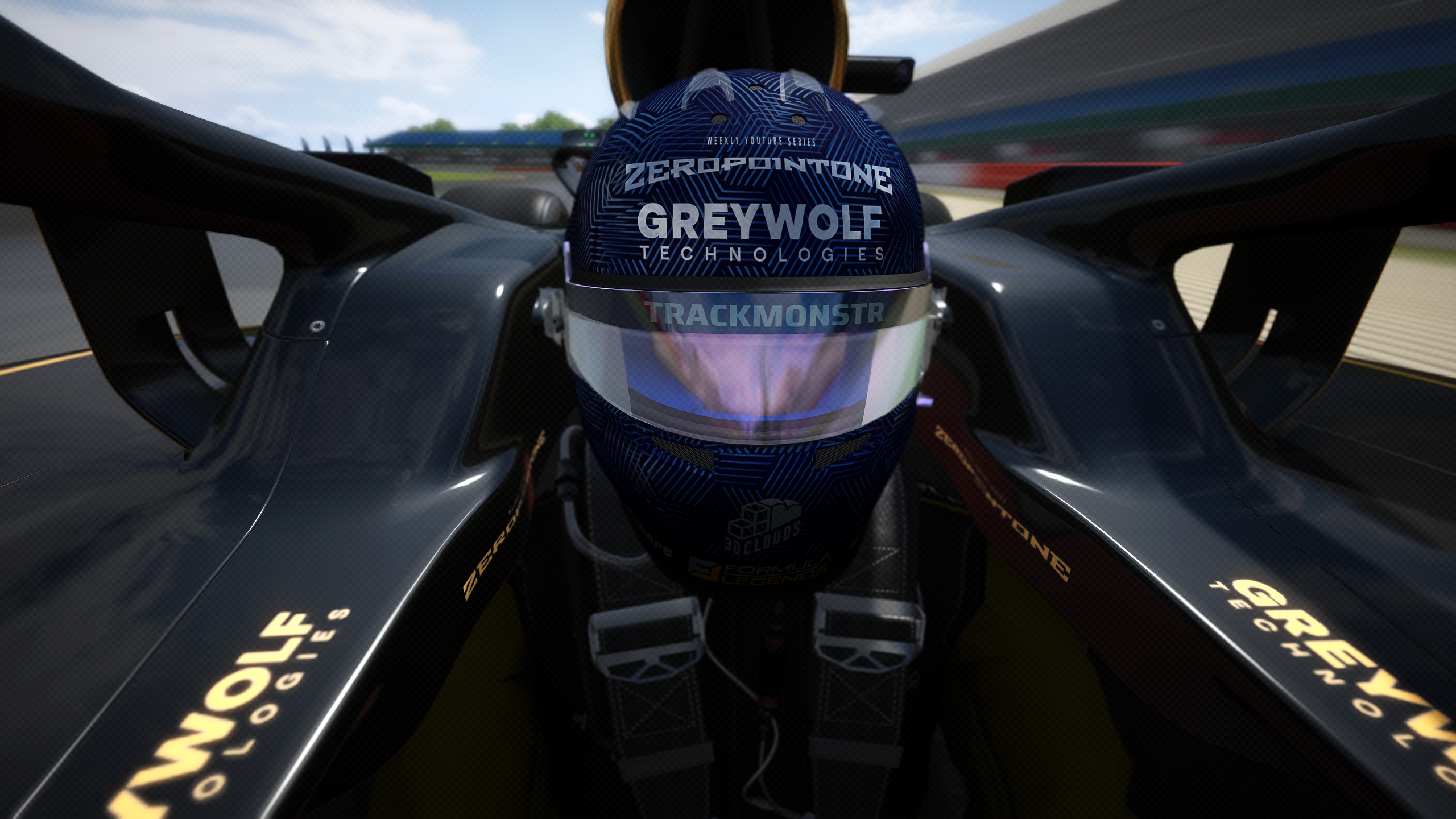
The question comes up often, from professional drivers and enthusiasts alike: is this actually training, or is it just a game? The answer depends entirely on the hardware. After a long session on a properly configured Trackmonstr turn-key, you are physically tired in ways that are specific and recognizable. That is not coincidence. It is engineering. And it's quantifiable.
Take a 40-minute GT3 race at Spa-Francorchamps on iRacing. Average lap time around 2:16, 19 corners per lap, 7 km of circuit. That is 17 full laps. Here is what your body actually does over those 40 minutes:
- 323 steering events — every corner navigated under active resistance from the Simucube 3 Pro
- ~136 hard braking events across 8 brake zones per lap, averaging 80 kg of pedal force, roughly 2 seconds each
- ~8 minutes of sustained steering load at 15–20 Nm through the arms, shoulders, and core
- 140–160 bpm sustained heart rate throughout — the same zone as a 40-minute tempo run
- ~300–400 kcal burned — comparable to a 40-minute cycling session at moderate intensity
- 0.3–0.6 kg of fluid lost through sweat, even without cockpit heat — purely from physical exertion and stress response
The Arms — 25 Nm of Resistance, 323 Times
The Simucube 3 Pro delivers up to 25 Nm of peak torque — the same order of magnitude as the steering forces generated by a real GT3 car at speed. Over 17 laps of Spa, that translates to roughly eight minutes of active resistance work through the arms, shoulders, and core. Not eight minutes of holding a static weight — eight minutes of dynamic, reactive loading where the force changes every fraction of a second in response to what the car is doing.
Formula 1 drivers are documented to lose measurable forearm muscle mass during a Grand Prix weekend. The mechanism is no mystery: sustained resistance work, under stress, repeated hundreds of times. A properly loaded simulator puts you through a scaled version of the same work. The quality that matters here is not peak torque — it is resolution. The Simucube's 23-bit encoder means you feel grip-state changes that are genuinely informative, the difference between a tyre that is working and one that is about to give up. That is the signal a real driver reads through their hands.
The Legs — 136 Brake Events at 80 kg Each
The Heusinkveld Ultimate+ handles up to 140 kg of brake force — enough to replicate the pedal loads of a Formula car. In a GT3 at Spa, threshold braking at around 80 kg, held for two seconds, repeated 136 times. That is the rough equivalent of 136 leg press repetitions at 80 kg, each requiring precise modulation from full threshold to trail braking to zero — while simultaneously unwinding the wheel and managing throttle application. No gym exercise replicates that coordination under fatigue.
The progressive elastomers and hydraulic damping on the Ultimate+ mean the force curve behaves like a real brake pedal rather than a digital switch. Drivers who train on these pedals develop threshold feel that transfers directly. Drivers who train on low-resistance potentiometer pedals develop something else entirely.
The Whole Body — Motion as Information
The Sigma Integrale DK2+ runs four actuators with 50 mm of travel, controlled by a 32-bit real-time ARM processor — not Windows, which cannot provide timing guarantees, but an embedded system that can. At Spa this means the platform pitches forward under hard braking at La Source, rolls through Pouhon, and delivers kerb transients at the Bus Stop that your body absorbs and interprets before your eyes have finished processing the image. A real driver reads the car through their seat and spine before they read it through the wheel. The motion platform trains exactly that.
The gym comparison is instructive precisely where it breaks down. Weighted exercises build isolated strength in controlled, repeatable patterns. A 40-minute race simulation at Spa builds something categorically different — coordinated, reactive physical responses under sustained cognitive load, in conditions that change continuously. You cannot replicate that with box squats and curls. The simulator does not replace physical conditioning. But it does something the gym cannot: it applies your physical capacity in the exact context where it matters, against the exact stimuli a race will produce, while simultaneously training the technical and cognitive skills that determine whether that preparation is used well. That convergence is what professional preparation looks like.